



Ask ten healthcare organizations what HIPAA-compliant cybersecurity services cost, and you’ll get ten different answers, and most of them will be wrong. The honest answer is: it depends on your size, your systems, and how much risk you’re currently carrying. But the range is knowable, and understanding it is the first step to budgeting correctly instead of either overpaying for enterprise tools you don’t need or underinvesting and leaving critical gaps.
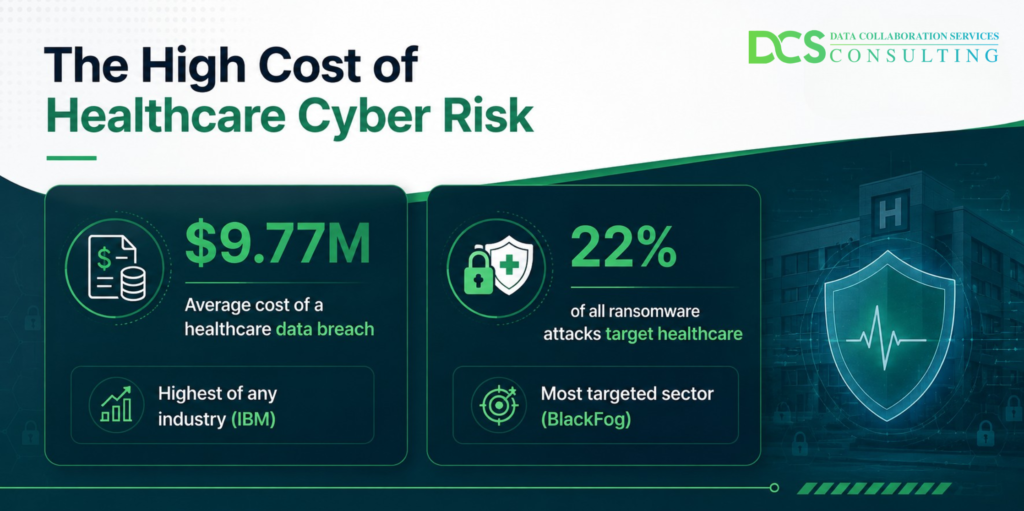
The stakes make this worth getting right. According to IBM’s Cost of a Data Breach Report, the average healthcare data breach now costs $9.77 million, the highest of any industry. And healthcare has become the single most targeted sector for ransomware, accounting for 22% of all ransomware attacks across every industry. Against that backdrop, the cost of healthcare cybersecurity services isn’t really an expense, it’s insurance against a catastrophic one.
Here’s a realistic breakdown of what it costs, what drives the price, and how to know you’re paying for the right things.
Why Healthcare Organizations Need HIPAA-Compliant Cybersecurity
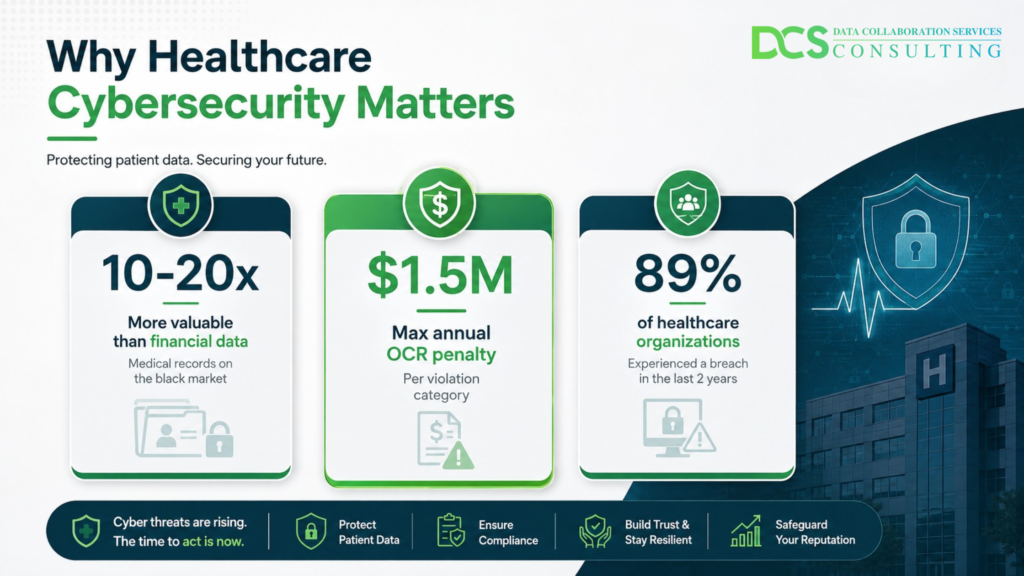
Healthcare organizations hold something more valuable on the black market than credit card data: complete medical records, often selling for 10 to 20 times more than stolen financial data because they combine identity, insurance, and medical information into a single reusable package for fraud.
HIPAA compliance isn’t optional. The Security Rule requires covered entities and business associates to implement administrative, physical, and technical safeguards to protect electronic protected health information (ePHI). The consequences of falling short are severe: OCR penalties range from $100 to $50,000 per violation, capped at $1.5 million annually per violation category and that’s before accounting for breach notification costs, credit monitoring, litigation, and the reputational damage that follows. 89% of healthcare organizations experienced at least one data breach in the past two years alone.
The most common threats driving these numbers: phishing targeting front-desk and billing staff, ransomware exploiting outdated legacy systems, and business email compromise targeting insurance and payment workflows.
What’s Included in HIPAA-Compliant Cybersecurity Services?
A genuine HIPAA cybersecurity services program covers considerably more than a single risk assessment. It includes:
- 24/7 security monitoring: Continuous SOC-based visibility across networks, endpoints, and cloud-based EHR systems.
- Endpoint protection: EDR deployed across every device that touches ePHI, including remote and mobile devices.
- Email security: Advanced phishing and impersonation protection for the most common healthcare attack vector.
- Vulnerability management: Ongoing scanning and patching of systems, especially legacy platforms common in healthcare IT.
- Incident response: A documented, tested plan for containment, notification, and recovery.
- Security risk assessments: The HIPAA-mandated foundation that identifies gaps and informs your entire security roadmap.
- Compliance support: Documentation, policy development, and audit readiness for OCR reviews and cyber insurance renewal.
A full walkthrough of how this comes together in practice is available in our
HIPAA Compliance Case Study: How DCS Helped a New York Clinic Secure Patient Data.
Factors That Affect Cybersecurity Costs
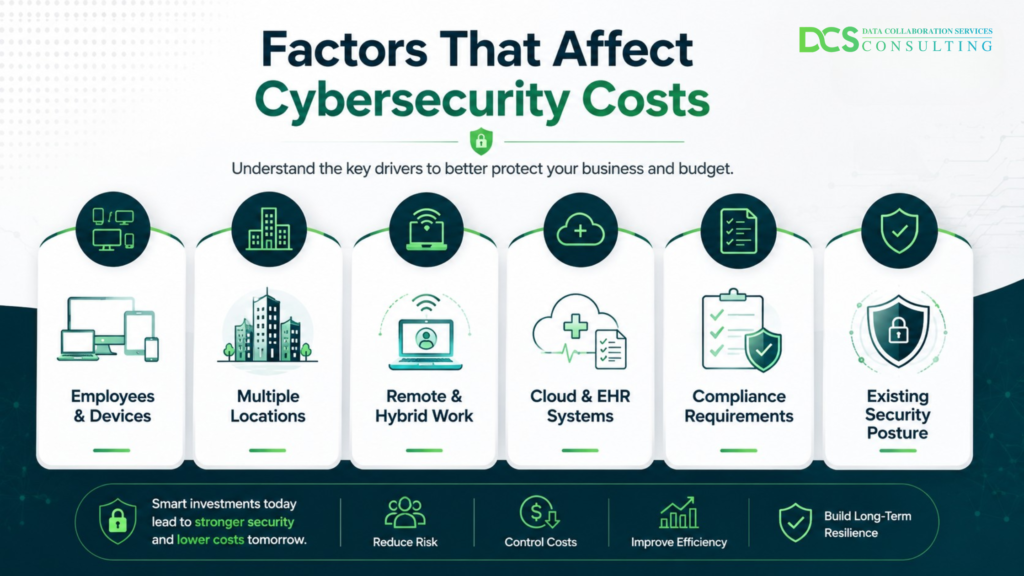
Several variables determine where your organization lands on the cost spectrum:
- Number of employees and devices: More endpoints mean more surface area to monitor and protect.
- Multiple locations: Each additional site adds network complexity and monitoring scope.
- Remote and hybrid workforce: Remote access introduces additional risk requiring VPN security, endpoint controls, and MFA enforcement.
- Cloud systems and EHR platforms: Integration complexity with third-party healthcare software affects both setup and monitoring costs.
- Compliance requirements: Organizations also subject to state privacy laws or handling federal contracts face additional layers.
- Existing security posture: An organization starting from near-zero pays more upfront than one with baseline controls already in place.
According to ComplyAssistant’s 2025 guidance, a small practice with a simple IT footprint sits at the lower end of the cost range, while a multi-location organization with custom software integrations requires deeper, and pricier, analysis.
Typical Cost Ranges for Healthcare Organizations
Based on current market data from HIPAA compliance specialists and cybersecurity providers, here’s what organizations typically pay:
| Service | Typical Cost Range |
| HIPAA Security Risk Assessment | $2,000 – $25,000 (small practice to multi-site org) |
| Managed Cybersecurity Services (MSSP) | $300 – $1,500+ per month, scaling with headcount and endpoints |
| 24/7 SOC Monitoring | Often bundled into MSSP pricing, or $500 – $2,000+/month standalone |
| Compliance & Reporting Support | $1,000 – $4,000 annually for risk assessment updates and documentation |
| Incident Response Services | $500 – $2,000 for tabletop exercises; retainer-based IR plans vary by scope |
| Full Annual HIPAA Compliance Program | $4,000 – $50,000+ depending on size and complexity |
Sources: ComplyAssistant (2025), Medcurity (2026), Regulance (2025), Accountable HQ (2026)
For context on the downside: the HIPAA Journal reports mid-range HIPAA compliance costs of $80,000–$120,000 for larger organizations managing compliance primarily in-house – underscoring why most small and mid-sized healthcare organizations find managed services more economical than building internal compliance infrastructure from scratch.
Is Outsourced Cybersecurity More Cost-Effective Than In-House Security?
For the vast majority of healthcare organizations, yes and the math is straightforward. A single security analyst salary averages $95,000–$130,000 annually, and a genuine 24/7 monitoring capability requires a minimum of three to four analysts to cover shifts, holidays, and turnover. That’s $300,000+ per year before factoring in tooling, training, and management overhead – for coverage a mid-sized MSSP delivers for a fraction of the cost.
Outsourced managed cybersecurity delivers:
- 24/7 monitoring without hiring, training, or retaining a full security team.
- Access to specialized healthcare compliance expertise most internal IT teams don’t have.
- Enterprise-grade tooling (SIEM, EDR, threat intelligence) at shared-service pricing.
- Scalability that matches your organization’s growth without new hires.
Even organizations with an internal IT team benefit. Healthcare cybersecurity services are structured to support existing staff, not replace them, adding specialized security coverage where in-house generalists can’t reasonably keep up.
How to Choose the Right HIPAA-Compliant Cybersecurity Provider
Not every MSSP understands healthcare. When evaluating a provider, prioritize:
- Healthcare industry experience: Familiarity with EHR systems, medical device security, and clinical workflows.
- Compliance expertise: Deep working knowledge of the HIPAA Security Rule, not just general cybersecurity.
- 24/7 threat monitoring: Genuine round-the-clock human coverage, not just automated alerting.
- Reporting and audit support: Documentation you can hand directly to OCR auditors or cyber insurance underwriters.
- Transparent, predictable pricing: Clear scope with no ambiguity about what’s included.
Know Your Number Before You Need It
The real cost of HIPAA-compliant cybersecurity services is almost always smaller than the cost of not having them. A HIPAA security risk assessment cost of a few thousand dollars is a rounding error next to a $9.77 million average breach. The organizations that treat security as a budget line item rather than a reactive scramble after an incident – are the ones that stay operational, stay compliant, and stay trusted by their patients.
DCS provides healthcare cybersecurity services and healthcare cybersecurity pricing built around real budgets and real risk – not one-size-fits-all packages. We help healthcare organizations across the United States understand exactly where they stand and what protecting their patient data actually requires.
Request a HIPAA Security Assessment to understand your risks, compliance gaps, and estimated cybersecurity costs. Schedule your assessment today or call (800) 922-7994.
Learn more about our HIPAA compliance consulting services and healthcare IT and cybersecurity solutions.