

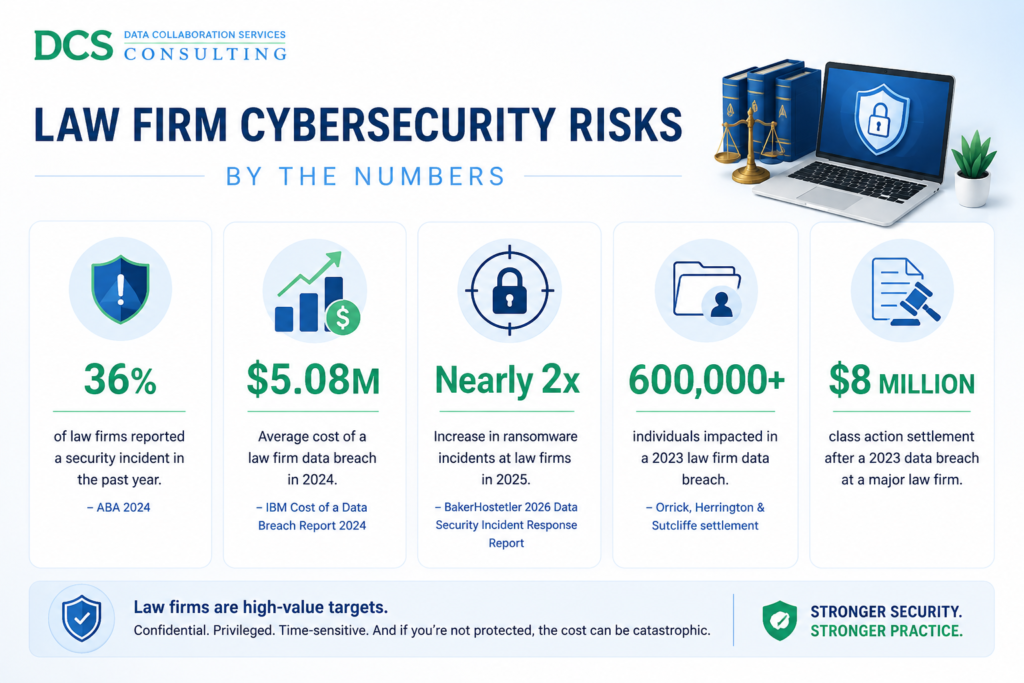
When Orrick, Herrington & Sutcliffe settled a class action for $8 million after a 2023 data breach exposing 600,000+ individual records, it sent a message the entire legal industry couldn’t ignore: law firms are high-value targets and the cost of unpreparedness is catastrophic.
The numbers back it up. 36% of law firms reported a security incident in the past year (ABA 2024). The average cost of a law firm data breach hit $5.08 million in 2024, up 10% year-over-year. And according to BakerHostetler’s 2026 Data Security Incident Response Report, law firms saw their ransomware incidents nearly double in 2025.
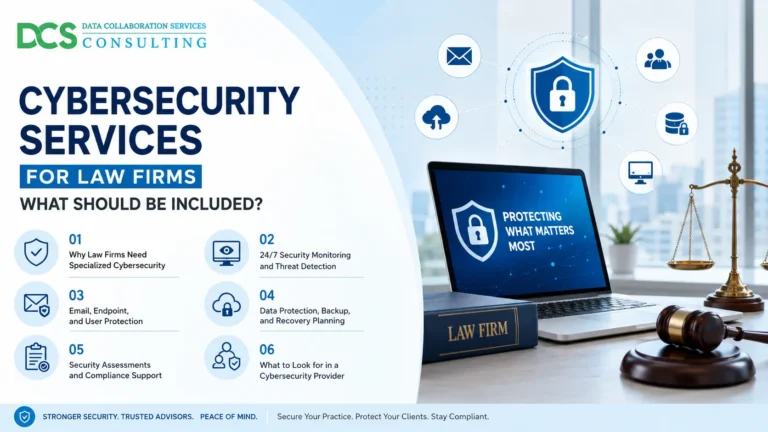
Law firms hold something cybercriminals value more than credit card numbers: confidential, legally privileged, time-sensitive information. M&A strategies, litigation files, settlement details, client financials. So, what does a proper cybersecurity services for law firms program look like? Here’s what every practice needs in place.
1. Why Law Firms Need Specialized Cybersecurity
General-purpose IT security doesn’t map to the specific threat profile of the legal industry cybersecurity environment. Law firms face a distinct combination of risks: phishing spoofing court communications, ransomware targeting case files under deadline pressure, Business Email Compromise exploiting wire transfer workflows, and third-party breaches through legal tech platforms (the 2023 MOVEit breach exposed multiple firms this way).
There’s also a non-negotiable compliance dimension. ABA Model Rule 1.6(c) requires attorneys to make “reasonable efforts” to prevent unauthorized client data disclosure – a bar that’s increasingly being tested in court. And 37% of legal clients in 2025 were willing to pay a premium for firms with demonstrably stronger security. Your cybersecurity posture is now a competitive differentiator.
2. 24/7 Security Monitoring and Threat Detection
Ransomware groups routinely deploy encryption payloads after hours and on weekends, specifically to maximize damage before anyone notices. For law firms operating with lean IT resources, this is a critical vulnerability. Comprehensive law firm cybersecurity services must include round-the-clock monitoring through a Security Operations Center (SOC) – not just automated alerts, but human analysts who can investigate threats and contain them before they spread.
Core components:
- Managed SOC with 24/7 visibility across your network, cloud systems, and endpoints
- Managed Detection and Response (MDR) – active threat hunting that finds threats before alerts fire
- Rapid incident response with expert-led containment to prevent lateral movement to client data repositories
DCS delivers managed SOC services for law firms and professional services organizations that need enterprise-grade monitoring without the cost of building an in-house security team.
3. Email, Endpoint, and User Protection
Most successful attacks on law firms start at an inbox or a device. 56% of firms that experienced a breach lost sensitive client information and phishing was the front door in most incidents. Advanced email security goes beyond spam filters to detect spoofed sender behavior, impersonation of judges or clients, and malicious attachments before they reach an attorney’s inbox.
On the device side, Endpoint Detection and Response (EDR) monitors every laptop, workstation, and remote device for behavioral anomalies – the early signatures of ransomware, unauthorized file access, or lateral movement.
Learn why: EDR is one of the most important investments a law firm can make.
Rounding out this layer: MFA enforced across all systems (email, document management, billing, VPN), and regular security awareness training. Only 37.8% of solo practitioners had formal training programs – a gap that phishing campaigns exploit daily. Managed cybersecurity for law firms addresses all three layers systematically.
4. Data Protection, Backup, and Recovery Planning
Staggeringly, only 43% of law firms conduct online backups (ABA). That means the majority are operating without a verified recovery path, which is exactly why ransomware groups target legal practices with such confidence. If your backups share the same network as your production systems, they offer no real protection.
A proper law firm data security solutions program requires:
- Immutable, off-network backups for all client files, matter databases, email archives, and billing data
- Tested restoration procedures – backups only matter if you can recover from them under pressure
- Role-based access controls to limit how much data any single compromised account can expose
- Documented ransomware recovery plan covering communication protocols for clients, regulators, and insurers
Also read: From Phishing to Ransomware: A Complete Guide to Cybersecurity
5. Security Assessments and Compliance Support
Law firms are accountable to overlapping compliance frameworks: ABA Rule 1.6(c), state bar guidelines, HIPAA (for healthcare clients), CCPA, and increasingly strict cybersecurity compliance for law firms requirements tied to cyber insurance renewal. Managing this without a dedicated compliance team is a real operational burden.
A strong managed cybersecurity for law firms partner addresses this proactively through:
- Cybersecurity risk assessments that map your current posture, surface gaps, and produce a prioritized remediation roadmap
- Vulnerability management with regular scanning across systems and legal tech platforms
- Compliance documentation for ABA obligations, state bar requirements, and applicable data privacy laws
- Cyber insurance support – helping document the controls underwriters require at renewal
- Client security questionnaires – increasingly required by corporate clients before outside counsel engagement
Regular network security audits are a foundational part of this process. Learn how network security audits help law firms identify and close vulnerabilities before attackers find them.
6. What to Look for in a Cybersecurity Provider
When evaluating a provider for legal industry cybersecurity, prioritize:
- Legal industry experience: Familiarity with Clio, iManage, NetDocuments, and attorney workflow.
- 24/7 human response: Monitoring is only valuable if backed by real-time expert containment.
- Compliance fluency: ABA Rule 1.6(c), state bar guidelines, cyber insurance documentation.
- Scalability: Programs that fit a three-attorney firm as naturally as a 200-person regional practice.
- Transparent SLAs: Defined response times, escalation paths, and post-incident reporting.
Protecting Client Trust Is a Professional Obligation
Clients share litigation strategies, financial vulnerabilities, and confidential information with their attorneys because the law demands protection and because they believe it will be honored. A data breach doesn’t just cost money, it breaks that trust in ways that are difficult to rebuild. Comprehensive cybersecurity services for law firms are a professional obligation, not just a technology decision.
DCS delivers managed cybersecurity for law firms across the United States, providing the monitoring, protection, backup, and compliance support growing practices need. We understand the legal industry cybersecurity environment – the threats, the obligations, the platforms, and the stakes.
Ready to assess your firm’s security gaps? Schedule a free cybersecurity assessment with the DCS team today, or call (800) 922-7994.