

What Happened
A trusted vendor became the back door
DocketWise is legal-tech infrastructure. Thousands of immigration attorneys run their entire practice on it – client intake, case files, supporting documents, the works. When you hand your matter to that kind of platform, you’re trusting that the vendor guards it as carefully as you would.
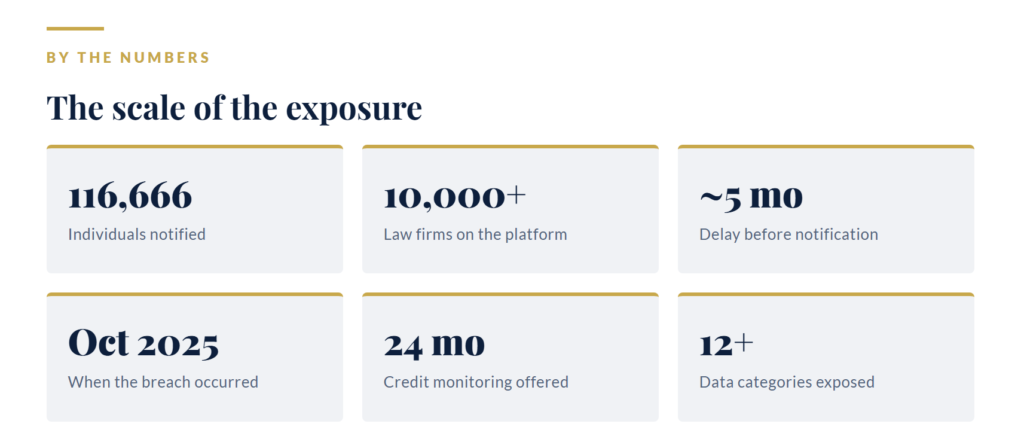
In October 2025, an unauthorized actor used valid credentials to clone third-party partner repositories tied to DocketWise’s data-migration pipeline. Those repositories held unstructured data belonging to law firm clients and their customers. No alarms, no broken locks – just legitimate-looking access to exactly the wrong place.
DocketWise discovered the intrusion in October 2025. But the 116,666 affected people weren’t notified until April 3, 2026 – more than five months later. For most of that window, the lawyers whose clients were exposed had no idea anything was wrong.
Key Facts
What was actually exposed
Data categories confirmed in the breach
- Names, addresses, and dates of birth
- Social Security numbers
- Driver’s license and passport numbers
- Government and tax identification numbers
- Financial account numbers, usernames, and access credentials
- Payment card numbers and card access information
- Health insurance policy numbers and medical condition / treatment information
- Usernames and access information for non-financial accounts
This is close to a worst-case data set. For an immigration client, these fields together are everything an attacker needs to commit identity theft, file fraudulent tax returns, or in this population specifically to intimidate, extort, or surveil vulnerable people.
The Cascade
One vendor, thousands of firms, a shared blind spot
Here’s the uncomfortable part: every one of those 10,000+ law firms could have had flawless internal security and still ended up in breach-notification letters. The weak link wasn’t the firm’s network. It was a repository sitting inside a vendor’s migration pipeline.
That’s the defining risk of 2026. Your data doesn’t live in one building anymore, it’s spread across case-management platforms, document portals, billing systems, and the “third-party partners” those vendors quietly rely on. Each link in that chain is a door into your clients’ files, and most firms have never audited who holds the keys.
When the vendor is breached, the law firm still owns the relationship with the client. The reputational damage, the awkward phone calls, the lost trust and those don’t get outsourced.
Legal & Regulatory Fallout
The lawyers are now the defendants
Multiple plaintiff firms have already opened class-action investigations into the DocketWise breach, focusing on both the exposure itself and the five-month notification delay. Notice was filed with state attorneys general, putting the incident squarely on the regulatory radar.
For affected law firms, the exposure runs two ways. Beyond their clients’ data being out, firms face their own duties, state bar obligations to safeguard client confidences, breach-notification statutes, and the growing expectation that attorneys perform meaningful due diligence on the technology vendors they entrust with privileged information.
Action Steps
What your firm should do this week
- Inventory your vendors. List every platform that touches client data – case management, billing, e-signature, document storage – and note what each one actually stores.
- Ask the hard question. Request each vendor’s breach-notification commitments and security attestations in writing. If they can’t answer how fast they’d tell you, that’s your answer.
- Lock down credentials. The DocketWise attacker used valid credentials. Enforce multi-factor authentication everywhere and rotate any shared or stale logins now.
- Write the breach plan before you need it. Know in advance who you’d call, which clients you’d notify, and what your bar requires, so a vendor’s bad day doesn’t become your crisis.
- Get an independent assessment. Have a third party evaluate your firm’s exposure across its own systems and its vendor chain. You can’t fix a risk you can’t see.
The Bottom Line
Your security is only as strong as your weakest vendor
DocketWise is a reminder that “we use a trusted platform” is not a security strategy. The firms in this breach didn’t fail at cybersecurity they failed to see how far their data had traveled and how little visibility they had once it left.
If you can’t say with confidence which vendors hold your clients’ Social Security numbers, how they’d protect them, and how fast they’d warn you, your firm is carrying a risk it has never measured. The good news: that’s a fixable problem and the fix starts with a clear-eyed look at where you actually stand.