
Your Website Is Updated. Your Plugins Are Patched. So How Could an Attacker Still Get Into Your Server?
You logged in on a Monday morning to find your website working normally. No obvious warning. No crashed application. No suspicious activity reported. But underneath it all, a PHP2Shell vulnerability could give an attacker a way to execute code on your server without ever logging in.
Yes! The PHP2Shell vulnerability refers to two critical flaws in PHP’s runtime, disclosed on October 21, 2026. They can allow unauthenticated attackers to execute code remotely, potentially exposing sensitive data, compromising servers, and disrupting business operations.
Here’s what makes this particularly concerning: patching your website or updating its plugins isn’t enough. The PHP runtime itself needs attention. And until organizations identify every affected environment, apply the security updates, and investigate potential signs of compromise, they may be leaving a door open that attackers already know exists.
What Happens When Your Website Becomes Your Biggest Business Liability?
Think about everything your website supports. Customer inquiries. Online orders. Appointment bookings. Payment processing. Client portals. Lead generation. Now imagine losing access to those services because an attacker compromised the server running them.
For a New York retailer, that could mean interrupted online sales. For a professional services firm, it could mean inaccessible client portals or exposed confidential documents. For a healthcare provider, a compromised server could put patient-facing services and sensitive information at risk, depending on what the server can access.
And the financial damage doesn’t necessarily begin and end with fixing the vulnerability. Businesses may face emergency incident response costs, forensic investigations, website restoration, lost revenue, customer notifications, legal reviews, and the expense of rebuilding customer confidence.
Why 70% of the Web is Suddenly Facing an RCE Security Crisis
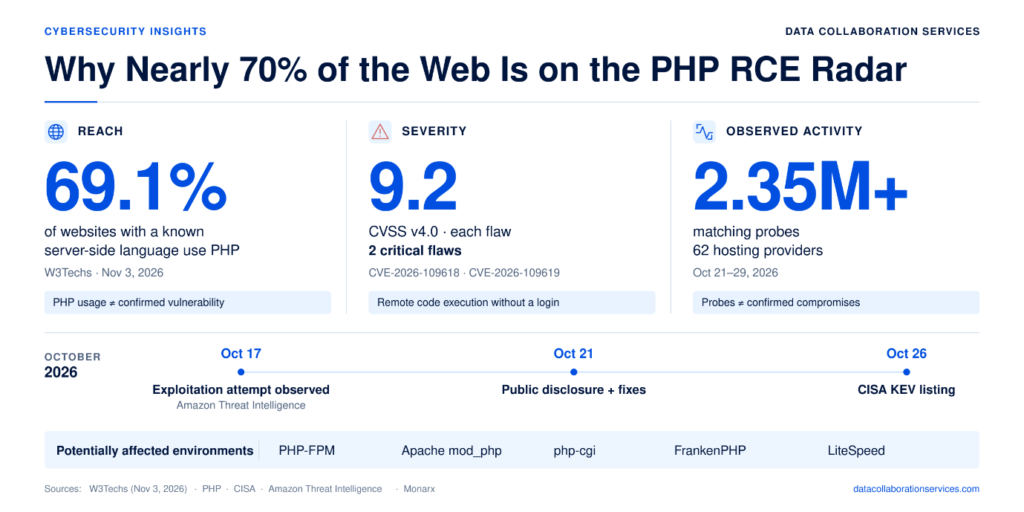
PHP is used by 69.1% of websites whose server-side language is known, according to W3Techs’ November 3, 2026 data. That is why PHP vulnerability 2026 enterprise risk belongs on the security agenda. This measures PHP’s reach, not confirmed vulnerable sites.
The flaws, CVE-2026-109618 and CVE-2026-109619, allow unauthenticated remote code execution in affected PHP environments. Both carry a CVSS v4.0 score of 9.2.
CISA added them to its Known Exploited Vulnerabilities catalog on October 26. Amazon Threat Intelligence identified an exploitation attempt on October 17, four days before public disclosure.
The PHP remote code execution vulnerability affects web-serving PHP installations, including PHP-FPM, Apache mod_php, php-cgi, FrankenPHP and LiteSpeed. PHP remote code execution zero-day describes the period before public fixes; unpatched systems remain exposed.
The Price of a Zero-Day: How a PHP2Shell Chain Reached a US Government-Affiliated Network
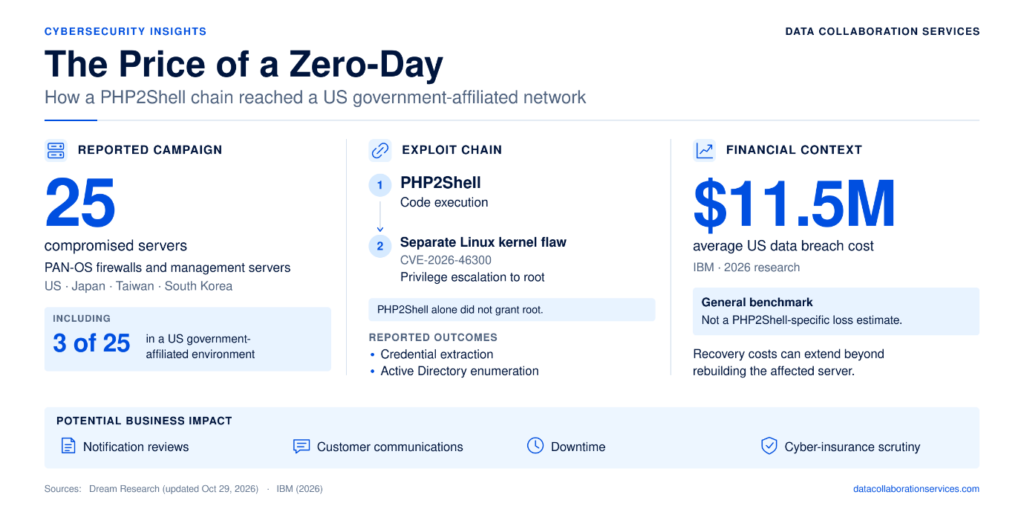
Dream Research reported a campaign that chained PHP2Shell with a separate Linux kernel privilege-escalation flaw, CVE-2026-46300, against PAN-OS firewalls and management servers. Its report describes 25 compromised systems across the US, Japan, Taiwan and South Korea, including three systems in a US government-affiliated environment. Attackers extracted credentials and enumerated Active Directory.
PHP2Shell enabled code execution; the second flaw elevated privileges. This was not automatic root access. It shows how an exposed web service can become a path into systems holding sensitive credentials and network access.
The PHP vulnerability financial impact can extend beyond rebuilding a website. IBM’s 2026 research puts the average US breach at $11.5 million. This is a general benchmark, not a PHP2Shell-specific estimate. An incident may also prompt privacy and regulatory notification reviews, customer communications, downtime and cyber-insurance scrutiny.
Understanding the Chain Reaction: From Memory Defect to Full Server Takeover
PHP2Shell refers to two flaws in PHP request handling:
- CVE-2026-109618: An out-of-memory condition can interrupt request processing while internal data is only partially initialized. Cleanup may then handle invalid data, creating a memory-corruption path: the PHP memory defect RCE.
- CVE-2026-109619: Internal request state can remain after its backing memory has been freed. A later request handled by the same worker may reuse that stale state.
How attackers exploit PHP vulnerabilities?
A crafted request targets PHP’s memory handling and may execute code without an application login. A PHP RCE exploit runs with the web server process’s privileges, not automatically as root. The impact depends on permissions, configuration, accessible data and network reach.
Why Your Web Application Firewall (WAF) Cannot Save You This Time
A WAF can filter suspicious requests and reduce exposure to known exploit patterns, but it is not a complete fix. PHP says temporary configuration changes may reduce specific attack paths; updating to a fixed release is the only complete remediation. That is PHP2Shell exploit mitigation.
Disaster Mitigation: A CISO’s Guide to Rapid Deployment and Server Hardening
How to protect against PHP2Shell exploit
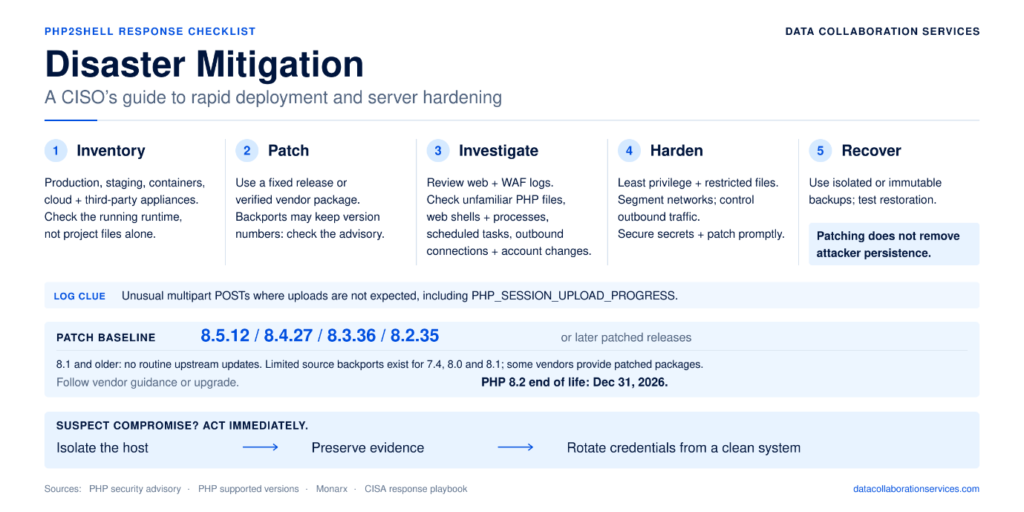
- Inventory every PHP environment: Include production, staging, containers, cloud workloads and third-party appliances. Check the running runtime, not project files alone.
- Apply the PHP2Shell vulnerability patch: Upstream fixed releases are PHP 8.5.12, 8.4.27, 8.3.36 and 8.2.35, or later patched releases. Linux distributions and LTS vendors may backport fixes without changing the upstream version number, so verify the vendor’s package advisory. PHP 8.1 and older no longer receive routine updates. PHP has issued limited source backports for 7.4, 8.0 and 8.1; some vendors also provide patched packages. Check vendor guidance or upgrade to a supported branch. PHP 8.2 reaches end of life on December 31, 2026.
- Look for signs of exploitation: Review web and WAF logs for unusual multipart POSTs to endpoints that do not normally accept uploads, including requests containing PHP_SESSION_UPLOAD_PROGRESS. Check for unfamiliar PHP files, web shells, unexpected processes, scheduled tasks, outbound connections and account changes. If compromise is suspected, isolate the host, preserve evidence and rotate credentials from a clean system.
- Strengthen the environment: How to prevent remote code execution attacks comes down to limiting what a compromised process can reach. PHP server security best practices include least-privilege accounts, restricted file access, network segmentation, controlled outbound traffic, secure secrets, tested backups and timely patching. These measures support Server hardening against PHP2Shell.
- Plan recovery: Keep isolated or immutable backups and test restoration. Patching does not remove an attacker who has already established persistence.
PHP also issued a separate October 23 advisory for CVE-2026-115560, an unlikely RCE vector requiring an unusual combination of session configuration and application behavior. Its temporary guidance is to set session.upload_progress.enabled=0 until the next regular bug-fix release. This is separate from the two PHP2Shell flaws.
How to fix PHP remote code execution vulnerability is an asset-inventory, verification, monitoring and recovery exercise, not just a patching task.
DCS has been helping businesses across the USA identify security gaps, prioritize remediation and strengthen ongoing monitoring.
Explore DCS cybersecurity services and 24/7 managed SOC services.
Request a security assessment to understand your PHP2Shell vulnerability risks.